




Workshop 1
Learning Differently
REFLECTIONS ON DYSLEXIA
A 2 hour or half day presentation about learning difficulties, in particular Dyslexia, suitable for all educators school support officers and parents.Mark Le Messurier's internationally acclaimed film; Reflections on Dyslexia is shown with this presentation.
 I'd like to change the world so that no one is diminished.

PREFACE
There is plenty of reputable information available about dyslexia and how to set students with learning difficulties up for success. Yet, poor understandings, unproved therapies, misguided interventions and folklore continue to flourish in pockets of our school systems, the media and our communities. ( http://www.dys-add.com/myths.html and http://www.dyslexiaassociation.ca/english/about_dyslexia.htm ).This film is designed for educators, parents & older students. It looks at the lives of four very different individuals who live with dyslexia. They tell how their learning difficulty has steered the choices they have made, what has helped and what has hurt along the way. They share humiliating, humorous, joyful and frustrating experiences in the hope that you might begin to understand.
INTRODUCTION
 The motivation behind constructing the film came from Darryl. I met Darryl five years ago. At the time, he was 45 years old and had recently been identified with dyslexia, and a full scale IQ of 126. It was an encounter that will always prick at my conscience. He was a delightful person, and now that he knew the true nature of his problem, a chronic learning difficulty, he really wanted to learn to read. Being able to develop basic reading skills would allow him to read the newspaper and discuss its contents. This was a high priority as it was something everybody at work did during smoko, lunch or in down times. In the space of several sessions a friendship and an energetic working relationship ensued.
Darryl was a part owner of a highly regarded landscape design and maintenance business, which he ran with his brother. Together they employed about twelve staff. They had run the business for more than twenty years and had built an impressive reputation in our city. Even though Darryl was the design and irrigation specialist, he had always relied on his brother to read all the documentation, business and personal, that came his way.
Darryl was a fit, alert individual who always presented himself well. His appearance did not belie the order he manufactured into his life. His life-time reading and writing disability meant he needed to store vast amounts of information in his memory, and to support this, he'd built systems around himself to maintain order. His brother and staff often poked fun at him about his meticulous adherence to order, the scrupulous physical appearance of his home, his resolute personal routine, the detailed way jobs were tackled and especially the fussy way he arranged the work tools. This was his way, and he described it as a way of knowing what he was doing. It was a way of controlling a successful part of his life.
During our time together, Darryl shared snippets of poignant information about his school days. As a young student he knew the sounds each letter made, but it took him longer to find the sound in his memory and say it, much longer to put sounds together to work out a word, and much, much longer to read sentences. Then, as if this wasn't frustrating enough, he would repeatedly trip over those small commonly used words. By year 4, because of his spectacular failure to read, spell and write, he was placed in an Opportunity Class (Special School).
Once this decision was made he was relocated to an adjacent campus resulting in isolation from his friendship group and from his brother. It was replaced by an unfamiliar peer group. A peer group that Darryl and his friends in the mainstream school had always looked on with contempt. His feelings of failure and despair were utterly overwhelming. He felt ashamed that his teachers, whom he held in such high regard, had wasted their time with him. He remembered feeling as though he had let his parents down as well. Darryl still remembers making sure he could walk home by himself some days. During the twenty minute walk he would cry softly. In his mind he played a game that the tears helped to wash away his dreadful embarrassment.
He recalled bringing home five or six new spelling words to learn each week. Soon a pattern emerged. Each night he would keenly copy them out, write them into sentences, and ask his father to test him, usually with a successful result. Then half an hour later when retested he had little idea of how to spell them. Worry about his performance always worsened his spelling result at school.
He vividly remembers his enthusiastic, almost evangelistic, year 5 teacher. She introduced an innovative coloured card system that she promised would solve his reading problems. Each card contained a sound, and the cards could be joined together to make words. Almost every day for two years he used the coloured card system. Darryl swears the system didn't solve his reading difficulty, but proved to be a reminder of just how “thick” he really was.
Darryl spent the remainder of primary school and the early years of secondary school in Opportunity Classes and before he finally left school he made what became a life-long promise to himself. As a means to insulate himself from any further humiliation over his learning difficulties he vowed never to let anyone too close, except for his brother, as the shame of having to explain to anyone that he couldn't do what they did so easily was too much. To this day Darryl has honoured the promise he made to himself as a young adolescent. He has avoided intimate relationships and has never invited anyone to share his life.
Darryl's story illustrates the deep impact an unrecognised chronic learning difficulty can have on an individual, their choices and opportunities. It highlights how easy it is to rob children with learning difficulties of confidence, hope and self-realisation, despite educators believing they are doing their best. It reminds us of the damage students with learning difficulties suffer through indifference, ignorance and inappropriate responses.
WHY A FILM?
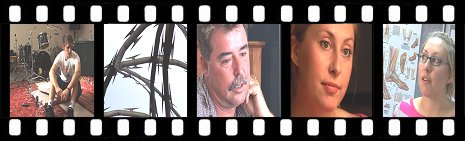
Darryl's story prompted me to look more closely at the lives of others who live with dyslexia.Imagine never being able to acquire adequate reading and writing skills and struggling to employ them every day at school or in the workplace? This is familiar territory for each of the four participants interviewed in this film. These individuals live with dyslexia. They discuss the emotional issues behind dyslexia, and how this disability has influenced their behaviour, opportunity, life choices and success.
As an educator do you sometimes wonder -
- how students with learning difficulties have coped since their school years?
- about the effectiveness of your involvement?
- what more you might have offered?
- and, whether it's possible to identify key elements that might set students with learning difficulty up for success?
CASE STUDIES
 Ross
RossAt 19 years of age Ross has long been identified as an individual with dyslexia and Attention Deficit Hyperactivity Disorder. Ross is also considered to be legally blind due to Macular Dystrophy. In earlier years, his impulsiveness, wavering concentration and dyslexia made it difficult for him to find success at school. Despite these stumbling blocks, his will to succeed and the dogged persistence of those close to him, has seen talents in mathematics, science and music emerge. He completed year 13 gaining an impressive Tertiary Entrance Ranking and was accepted into University to study for a Bachelor of Music in Jazz Performance. This exceptional bass guitarist has been influential in developing three bands. Ross has battled extraordinary odds and his story is one of success in the face of obvious hardships.
 Jane
Jane
At the time of filming this vibrant, articulate 24 year old was about to enter her second year studying Podiatry at University. Just two years before this, she was identified with Dyslexia and Attention Deficit Hyperactivity Disorder. She describes the diagnosis as a defining moment in her life. It finally made sense why she faced such difficulties with reading, writing and focusing her attention, despite her noticeable intelligence. Jane reflects on her learning experiences, motivations and aspirations. Her struggle to achieve her degree at University is immense. She knows that her academic success hinges on the support systems she has put in place, and how she approaches each and every task.
 Rick
Rick
Rick has always been a practical, resourceful and 'no-nonsense' sort of bloke. By age 17 he was employed in the oil and gas industry. At the time of filming Rick was 43 and managing a gas well in the jungles of Indonesia. Here, he is responsible for 130 personnel, logistics, budgeting, ordering components and the day-to-day operations. There was never a time in his life Rick didn't struggle with reading, spelling and writing. As a young child, he convinced himself that everyone found reading and writing as difficult as he did. Later, at secondary school, he was driven by the ambition to be the first in his family to achieve his high school certificate. Nearing the end of school he recognised that a practical, hands-on career would best suit his talents and interests. It wasn't until eight years ago when his youngest son was formally identified with severe dyslexia and dysgraphia that he recognised these same symptoms in himself, and in his two other children. Despite facing significant unidentified learning difficulties throughout school, he found ways to compensate, to feel confident and to excel.
 Gemma
Gemma
Gemma's 24 years have not worked out the way she had hoped. Years of chronic family problems, a string of foster care situations and successive primary school placements masked her significant concentration and learning difficulties. Today Gemma is able to reflect on why learning was so threatening. She couldn't read, couldn't spell and couldn't write much at all. In the classroom she felt constantly overwhelmed and vulnerable. Her response was to bluff, be confrontational and act in aggressive ways that she felt saved her dignity. By the time she entered secondary school Gemma found a way of life that was more accepting of her than school. She knows that her unidentified learning difficulties, in combination with other dire circumstances, are responsible for her unfortunate choices and lost opportunities. Although her learning difficulties are now recognised and she has the support to build literacy and work skills, her commitment still wavers. A simple thing, like filling out a form instantly reminds her of how “dumb” and inadequate she felt as a child.
DISCUSSION POINTS RAISED BY THE FILM
What's to be learnt from Jane?
I might not be able to read and write as well as you, but I beat
you in the playground every day when we run or play.
Jane's emotionally healthy attitude shines brightly. She hasn't let her learning disability define her and carries very little emotional baggage these days.
How might we support students we work alongside to develop Jane's healthy attitude?
Firstly, let's lead students to see themselves beyond a ‘dyslexic' or ‘specific learning difficulty' label.
Explore how dyslexia affects young people, but also assist them recognise their talents, unique style and interests. Explain, for example, that the organisation of the brain which produces the dyslexic difficulty is also thought to account for unique artistic, personal, musical, dramatic, athletic abilities and mechanical gifts.
Discuss the idea of strengths versus challenges. Make photographic displays to highlight this dynamic connection. Sadly, some of our students with learning difficulties lose sight of their natural abilities, and as they do, they progressively abandon hope for themselves.
By compartmentalising problems, individuals are less likely to become overly defined by their difficulties and more likely to see their difficulty as only one aspect of themselves. I remember a thirteen year old explaining to me how he felt about his dyslexia. Brett reached for a black jumbo sized texta and a blank sheet of paper. Then, he proceeded to place dozens of dots randomly over the page. He explained that each dot represented something about him. He explained that this dot, as he circled it, is all about my downhill racing, this next one is the naughty enjoyment I get from graffiting, and this one shows how I feel about my friends and so on. Finally, his last circle represented the impact of his significant learning difficulty. From Brett's perspective, his learning difficulty was but one aspect in the richness of his life. Recognising the link between what an individual has as strengths, and what they need to make more of, has a direct influence on tenacity and motivation.
Jane made the point that identifying her learning difficulty and ADHD really helped. It had placed her difficulties into perspective for herself and her family.
When I found out I had dyslexia it answered a lot of questions for me, and for my
mum. Once I found out I felt I'm not just the dumbo. It was about my learning.
Then, I knew there were things I could put into place to learn better.
Similarly, Ross commented that, “It's important to know you have dyslexia.”
A simple thing to do is to investigate a few of the amazing individuals from the past and present identified with learning difficulties. Guide students to discover their rich, wonderful lives, and the contributions these people have made. Many of their autobiographies and biographies are inspirational. Look at the problems they faced, how they got around them and why they became successful. Highlight that most individuals identified with a learning difficulty say they would never trade away their difficulty because without it they would not be complete.
Outstanding individuals believed to have dyslexia;
- Winston Churchill, former prime minister of England ( http://www.dyslexiamentor.com/famous/famousdyslexics_010.php )
- Whoopi Goldberg, actor and comedian ( http://www.whoopi.com )
- Ann Bancroft, first woman to cross both the North and South Poles ( http://www.yourexpedition.com )
- Agatha Christie, prolific author ( http://www.dyslexiamylife.org/who_els.html )
- Tom Cruise, actor ( http://www.audiblox2000.com/tom-cruise_dyslexia.htm )
- Cher, actress and entertainer ( http://www.clubi.ie/dyslexia/famous.html )
- Vanessa Amorosi, singer ( http://www.schwablearning.org/message_boards/view_messages.asp?r=281&m_id=2071 )
- Henry Winkler, actor, producer and director ( http://www.post-gazette.com/pg/04319/410530.stm )
- Charles ‘Pete' Conrad, astronaut ( http://www.dyslexia-hawaii.org/famous.php )
- Jamie Oliver, chef and television personality ( http://www.xtraordinarypeople.com/m )
- Jodie Kidd, international model and actress ( http://www.guardian.co.uk/health/story/0,3605,1021428,00.html )
- Richard Branson, entrepreneur and CEO of Virgin Airways ( http://www.beingdyslexic.co.uk/information/famous/richard-branson.php )
- Erin Brokovich, exposed Californian utility that was contaminating local water ( http://www.starbulletin.com/2000/03/21/features/story1.html )
- Walt Disney, ( http://www.dyslexiamylife.org/wb_who_els.htm )
Jane: an update
Jane brought her University studies to a close at the end of the year she appeared in the film. Even with part-time study, the demands on her ability to read, write essays and churn through a constant stream of exams were just too much. Shortly afterwards she found employment with Puma, an international sportswear company. Currently she is state manager for South Australia and the Northern Territory. Jane loves her work with Puma! When she's not in her office she is usually visiting stores to replenish stock, and delighting in the relationship she has built with clients. Jane recently mentioned, that she has finally, “come out.” She now feels comfortable enough to say to clients, “Hey, you know I'm dyslexic. You'd better watch me write the order and check it, or better still email it directly to me!”
Jane is still keen to return to university and complete a Podiatry degree. Very recently she entered into negotiations with Puma and The University of Adelaide to find a viable way to make this happen.
What's to be learnt from Ross?
I think that without dyslexia I'd be a more boring person. It's a
vital part of my character and I wouldn't give it away for anything.
Ross recognises his combination of disabilities and warmly embraces them. He accepts them as part and parcel of himself, and believes they provide him with …. “a different way of thinking to other people. Hopefully, this will help me to create my own niche to succeed in life.”
We also learn from Ross the importance of having a mentor; someone to bounce around ideas and problems with. At school, a mentor can be anyone; a teacher, a school support officer, an older student, a grounds-person, school counsellor or principal. Within schools untapped resources exist for regular on-site mentoring. One approach is for a student to check in with their mentor to review the week, to make planning adjustments and organise for what is upcoming. This relationship acknowledges the extra effort learning difficulty students put into every piece of work.
Mentoring can also take place outside school through a friend, therapist, parent, relation or older sibling. What appears almost universal in quality mentoring relationships is that the mentee sees their mentor believing in them and is more likely to accept routine and structures, build goals, feel greater motivation, develop academic skills and discover more about themselves. Ross has also started on his own mentoring journey, but this time as a mentor. He now works part time in my practice supporting students with learning and motivational issues. Recently, I organised for a year 9 student, Adam, who has a severe learning difficulty, to meet with Ross. The idea was for them to compare their thoughts about the impact of learning difficulty on their lives, and perhaps begin a mentorship. When I saw Adam again I asked him how he found Ross. Adam had never been so animated! His reply was, ‘Ross made me feel so good. I get it now. I just have to stop fighting this disability. And, it's okay to call it a disability. It was the first time for ages I've felt happy about me.' Interestingly, Adam's father, Robert, had a similar reaction, saying, “If I didn't know you as I do Mark, I could have thought the meeting with Ross was a set up. Ross has done so well, but it's been hard work. He's made me re-think my attitude towards my own dyslexia as well.”
There's just nothing like a first hand experience. Soaking up what made the difference for someone else with a learning difficulty gives a young person a true glimpse of how they can make the most of that attitude.
Bring adults who experience learning difficulties into the classroom to meet students, or make arrangements to visit them. Following this kind of encounter one idea is to ask students to make a movie, a slide show or prepare a photographic display called - “Surviving against the odds” – the display might depict several people, some they have met and others they have learned about, who learned to compensate for their learning difficulty and became successful in life.
Ross: an update
Ross is in his last year of study at the University of Adelaide. This year he will complete his degree; a Bachelor of Music in Jazz Performance. Ross admits to being a very, very slow starter at school, but these days he's absolutely tenacious in his approach to university study, his music and the development of his band. His band, ‘Move to Strike' is well known throughout Australia. They have recording contracts in place and continuously play at live venues in all states. This year they appeared at ‘The Big Day Out' concerts around Australia. Ross also works within my own practice mentoring young adolescents, often with learning difficulties, and has a real gift when it comes to imparting maths, physics and chemistry knowledge to older adolescent secondary students.
Ross isn't too sure what may eventuate after he completes university. One idea is to combine his two passions; teaching and music. He is also playing with the idea of beginning an Engineering degree!
What's to be learnt from Gemma?
I'd get (when reading in front of other students) frustrated and angry. I'd be naughty or just get up and leave. I couldn't read properly. I didn't know why. My auntie said that reading would come with age, but it never did.
Gemma is a heartrending reminder that learning difficulties, in combination with ADHD and dire family circumstances, can so easily transform a life with promise into one that is extraordinarily complex, debilitating and distressing.
Her story mirrors the insight gained in 2005 when almost 3000 people with learning difficulties were surveyed in the UK ( http://www.strategy.gov.uk/work_areas/disability/index.asp ). The results showed people with learning dfficulties, compared to those without learning difficulties, are more likely to be linked to crime, either as a victim or perpetrator, to live in depressed socioeconomic areas, not to have paid employment and not to have independent control over how they live.
I know Gemma would like to believe that the way her life has worked out isn't a complete waste. This was the motivation for her participation. She wanted to share her journey because it raises the obvious significance of creating optimistic environments for our children. The message for educators is breathtakingly simple. Sometimes, when students' home lives are not so good, the best that we can do is to guarantee that school is a steady, encouraging place providing opportunity for connectedness, both emotionally and academically.
Gemma was testy, petulant and naughty at school. She was hard to manage and easy for teachers to dislike. She now understands the cluster of reasons behind this, and one of the most significant was that she couldn't read, couldn't spell and couldn't write much at all. In the classroom her severe learning difficulty resulted in her feeling overwhelmed, exposed and “just plain stupid”. She never found a way to feel connected to school, to a staff member or to learning. Instead, she looked to impress others who had become exiled from the school system.
Gemma's behavioural response, just like a number of students with dyslexia, was to bluff, be confrontational and act in ways she felt saved her dignity. This is a salient clue that something always lays beneath behaviour. As parents and educators, our task is to find out what is driving the behaviours, to discover what they are really saying. Sometimes, when we're caught up in the middle of difficult behaviours it's easy to forget that observation and conversation are our greatest tools.
Gemma: an update
Gemma continues to serve time in prison, and will do so for a long time to come. Since participating in the film she has remained determined to improve her reading and writing skills. With continued intervention and practice her literacy skills have strengthened. Her reading has developed to a point where she reads simply for pleasure every night before lights out. Recently, Gemma has taken on the role of a reading coach for “two of the younger girls” in the Education Centre. She says it helps her as much as it helps them.
What's to be learnt from Rick?
I took subjects that didn't involve too much reading and writing.
I think if you enjoy something, you should go for that!
The obvious thing Rick offers is his disarming pragmatism.
He made a decision early in life that the practical and technical classes at school were more achievable and enjoyable. A little later he discovered that these subjects could lead to real work in the real world. This realisation, and the motivation to be the first in his family to obtain a High School Certificate, gave Rick the impetus to stay connected to school and complete a qualification that would set him up for success.
An increasing number of secondary schools in Australia are now offering Vocational Education and Training courses, known as VET ( http://www.australia.gov.au ). VET is a perfect solution for students who wish to remain at school, but want to enter the work force sooner rather than later. The school is able to manipulate a lighter academic load so students are not disadvantaged while away at a TAFE training campus ( http://www.seeklearning.com.au & http://www.tafe.sa.edu.au ). VET enables these students to have the best of both worlds as students are able to obtain nationally recognised units which make up their VET training and the successful completion of their high school certificate.
Rick also mentioned that his children have dyslexia as well.
Jake, his youngest child, is now eighteen years of age and is currently completing his final year of secondary school. I've had the privilege of mentoring and working alongside Jake over the past ten years. Just like his father, Jake is very much a down-to-earth individual. Very early on Jake could see the value of using the keyboard. It immediately made his writing look better and, as his reading gradually developed, it wasn't long before he was finding benefit from the spell check.
Late in primary school he began to use software called TextHelp Read and Write Gold ( http://www.texthelp.com ). This is a word-processing program intended for use alongside Microsoft Word. It can read out words as they are typed, read back text, check spelling and can automatically correct frequently made errors. It enables the user to listen to what they have written making it invaluable for editing and proofreading work. Similar word processing prediction programs are: Text EaseCT ( http://www.softease.com/textease.htm ) , Clicker 5 ( http://www.cricksoft.com ), Penfriend (http://www.penfriend.biz), Co:Writer (http://www.donjohnston.com) and Kurzweill 3000 ( http://www.kurzweiledu.com ).
Jake, driven by his dislike for reading, has always had a sixth sense at discovering ‘freeware' to convert text to speech. Here are several new sites, some offering free downloads, well worth looking at –
< >
Help Read,
(
http://www.Helpread.net )
Microsoft Reader PC,
(
http://www.microsoft.com/reader )
Read Please,
(
http://www.readplease.com )
Power Talk,
(
http://fullmeasure.co.uk/PowerTalk/ReadMe.htm )
Also when using the web keep in mind that there are thousands of free sites that are able to convert text into speech. Begin with –
< >
University of Virginia's E-Book library,
(
http://www.etext.org/index.shtml )
Internet public Library,
(
http://www.ipl.org )
Over the past four years Jake has taken advantage of Dragon NaturallySpeaking ( http//:www.voiceperfect.com.au ). This new generation software converts what's said into print. The future is here and the price of this product continues to fall. It is useful for students who have handwriting problems, spelling difficulties or can't type. Training the program doesn't take long and students find it inspiring. Jake is expecting to be able to use his Dragon NaturallySpeaking in exams later in the year as a part of his special provisions.
These new technologies have revolutionised how information can be gathered and delivered. The technology is ready and waiting. The larger issue is, are we adaptable enough as educators to accept the challenge?
Rick: an update
Rick continues to work in the oil and gas industry and enjoys the challenges that are always unfolding at work. At the moment he is managing a gas well in the Philippines and carries considerable responsibilities. He is in charge of 160 personnel, many of them locals, as well as overseeing logistics, budgeting, ordering and managing the day-to-day operations. As Rick says, “There's never a dull moment really!”
Rick continues to deal with his spelling and writing problem in his own humourous and unpretentious way. I remember Rick explaining that all the gas well managers are expected to write a report for the company each month, and that his report is always about a paragraph or two. However, he's noticed that most of the other managers write reports that are five or six pages long. His typical, wry conclusion was to say, “God knows what must be happening at their wells!”
CONCLUSION
If the histories of Jane, Rick, Ross and Gemma motivate you to review your opinion about learning difficulties, to exchange viewpoints with others, to gather more information, or to create better support options for students, then their experiences and contribution to this film have been worthwhile.I, along with many researchers and educators, believe it is possible to identify key elements that help clinch success for students with a learning difficulty. Our challenge is to take the step to transfer the clarity of understanding gained from research and experience into effective practices.
Structuring processes to sustain connectedness and engagement to learning is important for all students, and even more so for students with learning difficulties. To be candid, our children's success is entirely contingent on the informed, productive attitudes upheld by the adults around them.
READINGS
Berninger, V & Richards, T. (2002). Brain Literacy for Educators and Psychologists. New York: Academic Press.Cook-Sather, A. (2003). Listening to students about learning differences. Teaching Exceptional Children, 35(4), March/April, 37-42.
Hannell, G. (2002). Identifying children with special needs: Check lists for professionals. South Australia: Palmer Educational Publications.
Hannell, G. (2003). Dyslexia: Actions Plans for Successful Learning. Australia: Palmer Educational Publications.
Raskind, M., Goldberg, R., Higgins, E. & Herman, K. (2002). Teaching ‘life success' to students with LD: Lessons learned from a twenty year study. Intervention In School and Clinic, 37(4), March, 201-208.
Shaywitz, S. (2003). Overcoming Dyslexia: A New and Science Based Program for Overcoming Reading Problems at Any Level. NewYork: Alfred A Knopf Publishers.
Snowling, M. (2000). Dyslexia (second edition) London: Blackwell Publishers.
